




What Are Unlimited Residential Proxies Used For? 6 Use Cases



Clean IP picks: Static IPs from $1.5 each, Dynamic IPs from $0.5/GB


Data collection, cross-border e-commerce price monitoring, and SEO ranking tracking all have one thing in common: the longer they run, the more data they process.
GB-based residential proxies are flexible for testing, but as these tasks become routine, proxy costs rise with usage, making long-term budgets harder to control.
Unlimited residential proxies use a different pricing model—they charge based on bandwidth and usage duration rather than actual GB consumption. Which businesses are they suitable for, and when do they make more sense than GB-based pricing? This article breaks it down.
What Are Unlimited Residential Proxies?
Unlimited residential proxies typically refer to residential proxy plans that are not charged based on actual GB usage, but instead on bandwidth and usage duration. Within the bandwidth limits of the plan, users generally do not incur additional GB-based charges as traffic increases.
One thing is important to understand: “unlimited” mainly refers to traffic not being charged by the GB or having no preset traffic allowance. It does not mean there are no limits on speed, concurrent connections, IP volume, or request frequency.
The bandwidth limit (Mbps) of a plan determines its available throughput, while concurrency, Session limits, IP pool size, and regional availability still depend on the provider's terms. These details are more important to check than the word “unlimited” itself.
What Businesses Are Unlimited Residential Proxies Suitable For?
A simple rule of thumb: businesses with high traffic, long-running tasks, and frequent access across multiple regions are better suited to unlimited residential proxies, while low-volume or occasional use is generally more flexible with GB-based pricing.
1. AI Data Collection and LLM Data Processing
AI training and data analysis often require continuous access to large amounts of public web pages, text, images, and other data. For long-running, high-volume collection tasks, proxy costs can rise quickly with GB-based pricing.
Why unlimited proxies work well:
▸ Long-running tasks do not require frequent traffic top-ups
▸ Costs are easier to estimate for large-scale data transfers
▸ Residential IPs can be switched based on the target region
▸ Better suited to continuous data collection and less likely to be interrupted by exhausted traffic allowances
If you mainly collect text or API data and your traffic volume is relatively low, GB-based residential proxies may be a better fit.
2. Cross-Border E-Commerce Price Monitoring
Cross-border sellers, price comparison platforms, and data companies need to continuously monitor product prices, inventory, promotions, rankings, and competitor stores. These tasks typically involve high request volumes, broad regional coverage, and long-term monitoring.
Unlimited plans allow high-volume monitoring tasks to run without constantly tracking remaining traffic, making it easier to maintain multi-region, high-frequency price monitoring within a predictable budget.
If you need to run multiple monitoring tasks at the same time, choose a bandwidth tier based on your actual concurrency requirements.
3. Overseas Ad Verification and Landing Page Testing
Advertisers, media agencies, and anti-fraud teams need to verify whether ads are displayed correctly in specific countries or cities, whether landing pages and currencies work as expected, and whether there is any ad replacement or fraudulent traffic.
These checks are often performed repeatedly as part of ongoing monitoring. While individual requests may be small, total traffic can accumulate over time.
Using residential IPs from target regions provides an access source that is closer to that of a typical local user while avoiding the continuous accumulation of traffic charges during long-term monitoring.
4. SEO and Local SERP Rank Tracking
SEO teams need to regularly collect Google, Bing, and other search engine results from different countries and cities. The more keywords and locations you track, the more requests are required.
Search engines place strict limits on automated queries. Frequent automated requests may trigger CAPTCHAs or other access restrictions, and some data center IPs may be more likely to face such restrictions.
Using residential IPs from multiple regions can provide access sources that are closer to local users and help collect localized ranking data.
For large-scale tracking across many sites and keywords, unlimited plans can prevent proxy costs from increasing linearly with monitoring scope.
5. Overseas Market Research and Competitor Monitoring
Market research teams may need to access public websites, news sites, forums, e-commerce platforms, and competitor pages from different countries and regions to understand local prices, product information, and user discussions.
These tasks often involve long-running, multi-region, multi-platform monitoring, with request volumes increasing as coverage expands.
The broader the monitoring scope and the longer the tasks run, the more noticeable the budget benefits of an unlimited plan can be.
6. Video and Large File Transfers
This is a typical use case for unlimited plans: data transfer volumes are large and individual sessions can run for extended periods, causing GB-based costs to increase quickly with usage.
Typical tasks include overseas video content testing, video site access testing, media data collection, large file downloads, and network resource loading tests. These use cases also require higher throughput, so a higher bandwidth tier may be necessary.
Which Businesses Are Not Suited to Unlimited Residential Proxies?
Unlimited is not always the better option. An unlimited plan may not be necessary in the following cases:
▸ Occasionally checking a few web pages or using only a few GB of traffic per month
▸ Small-scale, short-term market research
▸ One-time testing before launch
If your business requires a fixed IP for an individual account over the long term, static residential IPs may be a better fit. They address the need for a fixed exit IP, which is separate from the pricing model.
The right approach is not to assume that “unlimited” is better, but to choose the pricing model that matches your traffic pattern.
Unlimited Residential Proxies vs. Traffic-Based Pricing
How to Choose Unlimited Residential Proxies
▸ Bandwidth. Estimate your actual throughput requirements first rather than simply choosing the highest tier. Text and API-based collection typically require less bandwidth, while tasks involving images, video, or large files require higher tiers.
▸ IP Pool and Geographic Coverage. IP pool size and geographic coverage determine the available resources for different use cases. If you need city- or country-level targeting, confirm that the provider offers IPs in the required locations. IPDeep covers 200+ countries and regions with more than 30 million IP resources.
▸ Protocol Support. Check whether HTTP, HTTPS, and SOCKS5 are supported and whether the proxies can integrate with your existing scraping frameworks or automation tools.
▸ Rotation Method. Check whether IPs rotate per request or by time, and whether Sticky Sessions are supported. The right option depends on your login state and task structure. Specific capabilities depend on the provider's plan.
▸ Concurrency and Limits. Confirm the plan's limits on concurrent connections, Session duration, and regional availability.
▸ Test in Practice. Before full deployment, run a small-scale concurrent test against your target sites to verify connection success rates and stability.
What Use Cases Are IPDeep Unlimited Residential Proxies Suitable For?
IPDeep offers both traffic-based and bandwidth-based pricing for its dynamic residential proxies. Businesses with variable traffic or occasional usage can choose traffic-based pricing, while long-running, high-volume tasks can use unlimited residential proxies with bandwidth-based pricing.
The bandwidth-based plans offer 100Mbps, 200Mbps, 300Mbps, 500Mbps, 600Mbps, 800Mbps, and 1000Mbps tiers. No additional GB-based traffic purchase is required during the plan period, and HTTP, HTTPS, and SOCKS5 are supported. Custom plans are also available for larger customers.
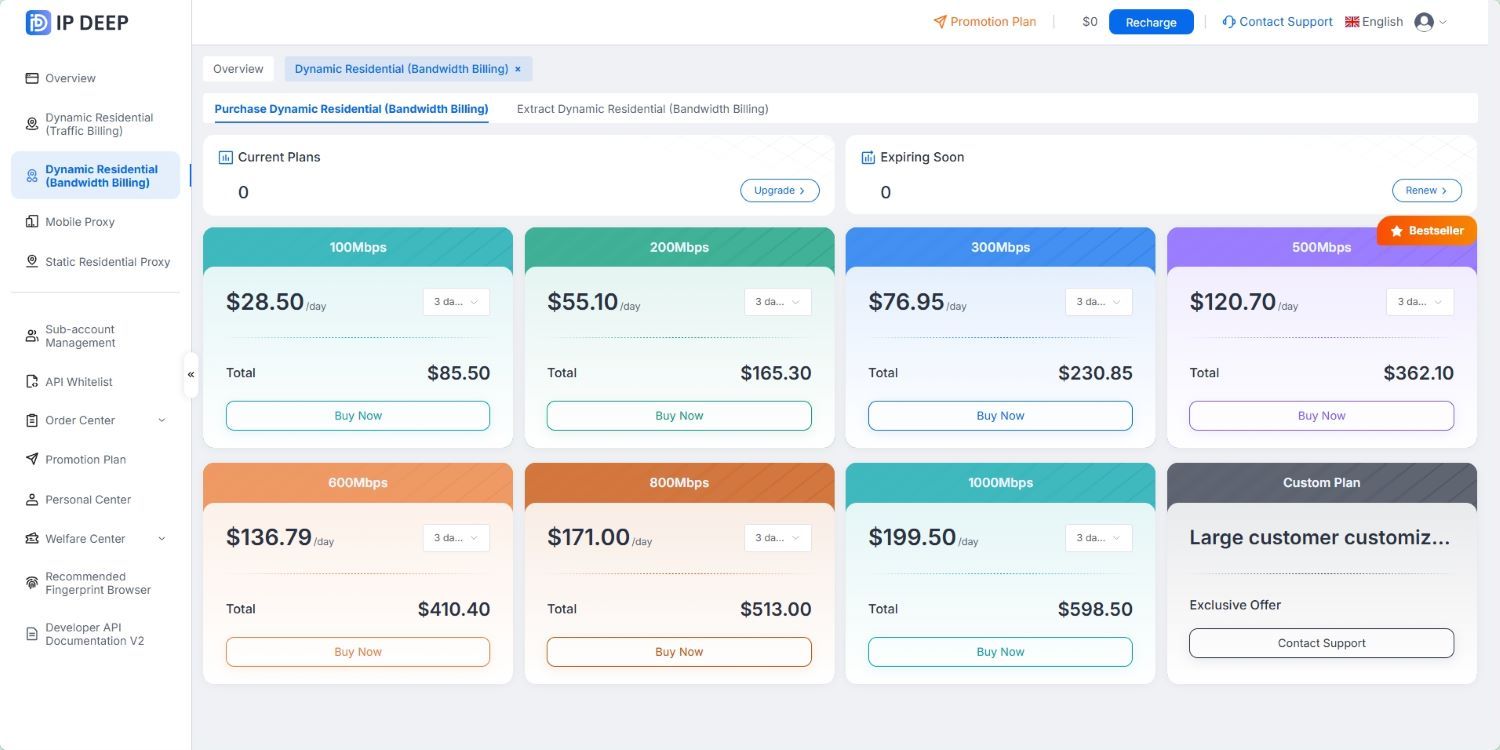
For long-running tasks such as AI data collection, search engine data collection, and price monitoring, you can choose a bandwidth tier based on your actual concurrency and data transfer requirements.
For use cases that require a fixed IP over the long term, static residential IPs may be a better fit. Specific bandwidth tiers, plan durations, pricing, and available locations are subject to the current information on the official website.
If your business involves multiple types of tasks listed above, you can start by testing one bandwidth tier and adjust it based on actual performance.
Frequently Asked Questions
Q1: Are Unlimited Residential Proxies Really Unlimited?
This typically means that you will not incur additional charges based on actual GB consumption during the plan period, rather than having no limits at all. Bandwidth, concurrent connections, Session duration, IP pool size, and regional availability are still subject to the plan's terms.
Before purchasing, confirm exactly what “unlimited” refers to.
Q2: Are Unlimited Residential Proxies Unlimited in Speed?
No. For bandwidth-based products, Mbps generally represents the plan's bandwidth limit and does not mean every request will reach that speed. In practice, 100Mbps and 1000Mbps plans can perform differently, especially for high-volume tasks involving images or video.
Q3: Are Unlimited Residential Proxies Suitable for Web Scraping?
They are suitable for long-running, high-request-volume, and data-intensive collection tasks. If you only need small-scale scraping or short-term testing, GB-based residential proxies are more flexible.
Proxies only address part of the network access layer. Target websites may also evaluate request frequency, cookies, browser characteristics, and other factors, so scraping performance depends on the overall setup.
Q4: Are Unlimited Residential Proxies Cheaper Than GB-Based Proxies?
It depends on actual usage. GB-based pricing is generally more flexible for low-volume tasks because you do not pay for unused traffic, while unlimited plans can offer greater cost advantages for long-running, high-volume tasks.
You can start with a simple estimate:
Estimated GB-based cost ≈ Average daily traffic × Number of usage days × Price per GB
Then compare the result with the price of an unlimited plan for the same period. Using average daily traffic from an actual usage period is generally more realistic than estimating from peak traffic.
If your actual usage is well below the cost threshold of the unlimited plan, GB-based pricing is generally more flexible. For long-running, high-volume tasks, an unlimited plan can provide more predictable costs.
Q5: How Many Mbps Should You Choose for Unlimited Residential Proxies?
It depends on concurrency and data type. Text and API-based collection typically require less bandwidth, while tasks involving images, rendered resources, or video require higher tiers. You can start with a lower tier, test actual performance, and adjust as needed.