




Best Proxies for Google Search Scraping: Unlimited Residential



Clean IP picks: Static IPs from $1.5 each, Dynamic IPs from $0.5/GB


Google search results vary by keyword, location, and search environment, so SEO rank tracking, competitor analysis, and localized search research often require ongoing SERP data collection across different regions.
As keyword volume and request frequency increase, proxy IP stability, IP rotation, and geographic targeting can directly affect collection efficiency.
So, what type of proxy IP should you use for Google search scraping? And are unlimited residential proxies suitable for long-term, large-scale collection? This article covers proxy types, pricing models, and practical configuration tips.
Why Do You Need Proxies for Google Search Scraping?
SEO rank tracking, competitor analysis, and localized search research often rely on automated collection of Google Search Engine Results Pages (SERPs). This can be more challenging than scraping regular webpages for two main reasons.
First, Google evaluates multiple signals when analyzing requests. Request frequency, IP reputation, access behavior, and browser and network environment can all play a role.
High-frequency scraping from a single IP or office network can quickly trigger CAPTCHA challenges, and the IP may be temporarily restricted.
Second, search results vary significantly by location. The same keyword can return different SERPs for users in different countries and cities. If requests only come from one location, the ranking data collected may not accurately represent the target market.
Proxies have a clear role here: they allow scraping requests to originate from the target region and use IP rotation to reduce the risk associated with repeated requests from a single exit IP.
They address the exit IP and geographic location rather than “bypassing Google’s security measures.”
One important note: Google’s current policies classify automated search queries without explicit permission, including SERP scraping for rank checking, as machine-generated traffic. Review and comply with Google’s relevant policies before conducting automated scraping.
Which Proxy IP Should You Choose for Google SERP Scraping?
The four common proxy types differ in how they perform for SERP scraping:
In short: no proxy type can guarantee uninterrupted SERP scraping.
Proxy type is only one factor. Request timing, session consistency, and browser environment also matter.
Why Are Unlimited Residential Proxies Suitable for Large-Scale Google Search Scraping?
If you only collect a small number of keywords each day, traffic-based residential proxies are usually sufficient.
However, as the number of keywords, target locations, and request frequency increase, traffic costs can quickly add up and become harder to predict.
Unlimited residential proxies typically use bandwidth- and time-based pricing, so you do not pay separately for each GB of traffic consumed during the plan period.
For long-running, large-scale keyword monitoring across multiple regions, this pricing model makes costs easier to predict.
Key factors to consider:
▸ Residential IP quality and availability. The exit IP should be identified as Residential or ISP by IP databases. A provider’s ongoing IP maintenance is often more important than the size of its IP pool alone.
▸ Bandwidth and stability. With bandwidth-based plans, Mbps determines the maximum throughput. High-concurrency tasks need sufficient bandwidth to avoid queuing and timeouts.
▸ Geographic targeting. Google rankings are highly localized, so the proxy service should support country- and city-level targeting to collect results for specific locations.
▸ Concurrency and protocols. Check the plan’s limits on concurrent connections, session duration, and IP rotation, as well as support for HTTP, HTTPS, and SOCKS5 to ensure compatibility with your existing scraping framework.
How Should You Configure Proxies for Google Search Scraping?
Proxies are only one part of the setup. The following factors can also affect scraping results.
▸ Rotation frequency. Adjust the rotation frequency based on keyword volume, request frequency, and IP quality.
Large-scale keyword collection can use per-request rotation, while tasks that require continuous sessions suit sticky sessions better. Determine the appropriate settings through testing rather than following a fixed rule.
▸ Request timing. Avoid sending large numbers of requests at fixed intervals. Set random request intervals based on the collection scale and prepare a backoff strategy for failed requests.
▸ Consistent request headers and environment. Set an appropriate User-Agent based on the actual access environment, and keep the browser timezone and language consistent with the proxy IP’s location. When using mobile proxies, use a corresponding mobile-device User-Agent where appropriate.
▸ Location parameters. For localized scraping, control the country, city, language, and other search parameters, and verify that the proxy IP’s actual location matches the target region.
Some scraping tools also use parameters such as uule to further specify the search location.
▸ Verify the exit IP. Before and after scraping, check the actual location and IP type to ensure requests aren't sent from an unintended region.
What SERP Scraping Tasks Are IPDeep Unlimited Residential Proxies Suitable For?
IPDeep offers both traffic-based and bandwidth-based pricing for its dynamic residential proxies. For businesses with unstable traffic volumes or occasional scraping needs, traffic-based plans may be more flexible;
for long-running tasks and large-scale keyword monitoring, bandwidth-based unlimited residential proxies can be a better fit.
Bandwidth-based plans include 100Mbps, 200Mbps, 300Mbps, 500Mbps, 600Mbps, 800Mbps, and 1000Mbps options.
No additional GB-based traffic purchase is required during the plan period. They support HTTP, HTTPS, and SOCKS5, cover 200+ countries and regions, and provide access to 30M+ IP resources.
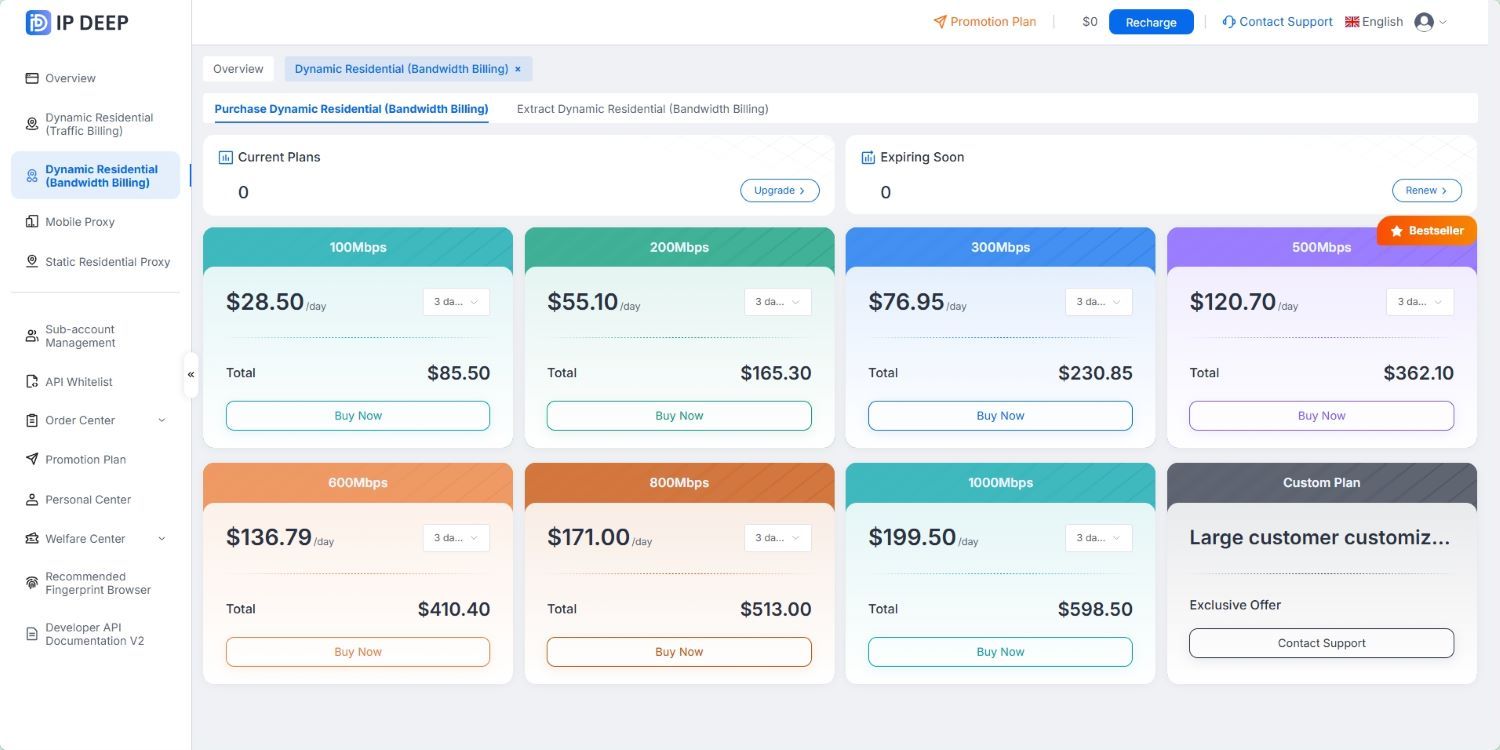
Check the official website for the latest bandwidth options, plan periods, pricing, and available locations.
Frequently Asked Questions
Q1: Are unlimited residential proxies suitable for Google search scraping?
They are suitable for long-running scraping tasks with broad keyword and geographic coverage. If you only collect a small number of keywords occasionally, traffic-based residential proxies are usually more flexible.
The right choice depends on your actual data volume and usage duration.
Q2: Why do I still get Google CAPTCHAs when using residential proxies?
Residential proxies change the source of the exit IP, but Google also considers signals such as request frequency, behavior patterns, User-Agent, and whether request parameters are complete.
Excessive concurrency, fixed request intervals, or inconsistent environment parameters can still trigger verification.
Residential IPs only reduce some of the risk and do not guarantee uninterrupted access.
Q3: Should I use rotating or static residential proxies for Google SERP scraping?
It depends on the task. For large-scale, multi-region scraping that requires switching exit IPs per request, use rotating residential proxies;
for tasks that require persistent sessions, continuous pagination in the same location, or multi-step operations, static residential / ISP proxies are a better fit.