




Unlimited vs. Metered Residential Proxies: Pricing, Traffic & Use Cases



Clean IP picks: Static IPs from $1.5 each, Dynamic IPs from $0.5/GB


Residential proxies generally use one of two billing models: pay for the actual traffic used (GB), or pay based on bandwidth (Mbps) and the usage period.
The former is typically a metered dynamic residential proxy, while the latter is an unlimited residential proxy.
Both use dynamic residential IPs, with the main difference being how they are billed. This article compares their pricing, traffic usage, and use cases.
What’s the Difference Between Unlimited and Metered Dynamic Residential Proxies?
First, one point that can be confusing: unlimited residential proxies are not the opposite of dynamic residential proxies.
IPDeep’s unlimited product is also a dynamic residential proxy. The difference is that it changes the billing model from per-GB pricing to bandwidth + usage-period pricing.
The key difference is simple: one charges by traffic, while the other charges by bandwidth.
How Is the Pricing Calculated?
The two billing models can be simplified into these formulas:
Monthly cost for metered proxies = Actual traffic used × Price per GB
Monthly cost for unlimited proxies = Fixed fee for the selected bandwidth plan
Here’s a simple example without using pricing from any specific provider. Suppose a scraping project transfers 500 GB of traffic per month:
Metered billing: 500 × price per GB. If usage doubles, the cost increases proportionally.
Bandwidth billing: You pay the fixed fee for the selected bandwidth plan, with no additional charge based on the amount of GB used.
So the key factor is not simply the per-GB price, but whether your monthly traffic is likely to remain stable or continue growing.
If you’re not sure about your monthly traffic yet, you can start with metered billing for a month, measure your actual usage, and then decide whether to switch to bandwidth-based billing.
Does Unlimited Become More Cost-Effective as Traffic Increases?
Generally, higher traffic makes unlimited plans more cost-effective, but it still helps to look at different usage ranges:
▸ Under a few dozen GB: Metered billing is usually more flexible for small workloads or projects with irregular usage.
▸ Around a few hundred GB: Plug your actual traffic into both pricing formulas and compare the costs.
▸ Several hundred GB to TB-level traffic with sustained usage: Bandwidth-based billing generally makes it easier to control the budget, especially for consistently high-volume workloads.
Don’t look only at the advertised price per GB. A more practical approach is to calculate the actual cost per valid data record:
Actual cost per valid data record = (Proxy costs + compute and storage resources + retry and parsing costs + operational labor) ÷ Number of validated data records
From this perspective, unlimited billing mainly changes how proxy costs are calculated, turning traffic-dependent proxy expenses into a more predictable fixed cost.
Residential IPs, meanwhile, address network egress and geographic targeting. The total cost should also take response success rates, retry volume, and computing resources into account.
Are Unlimited Residential Proxies Really Unlimited?
“Unlimited” means there are no additional per-GB charges during the plan period. It does not mean every usage dimension is unlimited.
▸ Mbps is bandwidth, not a speed guarantee: A plan listed at 300 Mbps or 500 Mbps refers to the overall throughput capacity of the plan, not the speed of a single request or device. Actual speeds also depend on the target website and network route.
▸ IP pools and regional availability are still limited: Dynamic residential IPs can rotate, but that does not mean unlimited concurrent access to IPs in a specific country or city.
▸ Concurrency and usage rules depend on the plan: Different providers may define “unlimited” differently.
Before purchasing, check the bandwidth, concurrency limits, IP pool size, geographic coverage, and fair-use rules.
IPDeep’s unlimited product uses bandwidth + usage-time billing, with no additional GB purchases required during the plan period.
Which Option Fits Different Use Cases?
Here are some typical use cases:
▸ AI data collection and training data preparation: When collecting large amounts of public text, images, and other data from the web, proxy traffic can grow quickly, making unlimited plans a good fit.
▸ E-commerce price and inventory monitoring: Frequently accessing large numbers of product pages over long periods can generate continuous traffic, making unlimited plans a good fit.
▸ Search data and SERP scraping: High concurrency and long-running tasks require consistent throughput, making unlimited plans a good fit.
▸ Ad verification, light scraping, and project testing: Usage is usually smaller and more sporadic, making metered billing more flexible.
For account management, store backends, and other use cases that require a fixed exit IP and persistent login sessions, neither type of dynamic residential proxy is ideal. A static residential IP is a better fit.
Dynamic residential proxies are designed for rotation and distribution, while static residential proxies provide a fixed exit IP.
IPDeep Unlimited Residential Proxies
IPDeep offers both metered dynamic residential proxies and bandwidth-based unlimited dynamic residential proxies. Both are backed by global residential IP resources and support HTTP / HTTPS / SOCKS5.
▸ Low traffic and variable demand: Choose metered dynamic residential proxies and pay for the traffic you use.
▸ Long-running, high-traffic workloads: Choose a bandwidth-based unlimited plan for large-scale data collection, AI data collection, e-commerce price monitoring, search engine scraping, and market research.
IPDeep’s unlimited dynamic residential proxies are available in bandwidth tiers of 100 Mbps, 200 Mbps, 300 Mbps, 500 Mbps, 600 Mbps, 800 Mbps, and 1000 Mbps.
You can choose a tier based on your workload, with no additional GB purchases required during the plan period. IP resources cover more than 200 countries and regions.
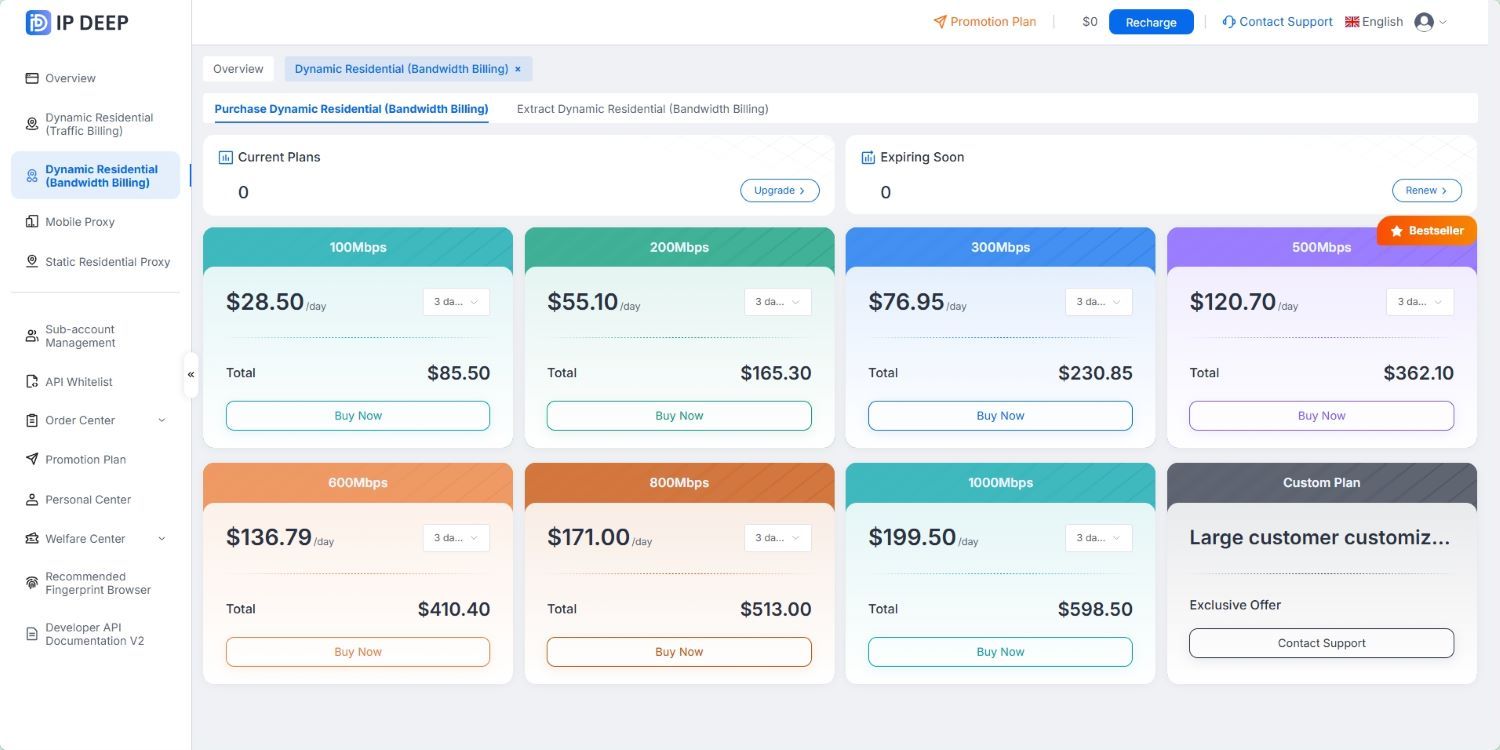
Check the current website for the latest bandwidth tiers, plan periods, pricing, available locations, and network performance.
How to Test Before Purchasing
You don’t need a full network procurement process. These three steps are usually enough:
1. Check the IP Type and ASN
Use a third-party detection tool such as ToDetect to check the ISP, ASN, network type, and other details of the exit IP and confirm that the IP has the residential network attributes your use case requires.
2. Test the Success Rate
Run your actual business script continuously for 24–48 hours and record the target website’s success rate and failure reasons.
3. Test Peak Performance and Actual Costs
Run the test during peak business hours to check response times and timeouts. Then plug your actual traffic usage into the formula in Section 2 and calculate the cost per valid data record.
Frequently Asked Questions
Q1: Are unlimited residential proxies really unlimited?
Unlimited means there are no separate per-GB traffic charges during the plan period.
Bandwidth, concurrency, IP pool size, and geographic coverage still have limits, and usage rules depend on the plan.
Q2: Which is faster, metered or unlimited residential proxies?
The billing model itself does not determine speed.
Actual performance also depends on the provider’s network routes, proxy node load, target website response times, and concurrency.
Q3: How should I choose if my traffic varies a lot?
Look at the usage pattern.
If you have long periods with little or no traffic and occasional spikes, metered billing is a better fit.
If you have consistently high traffic every month, bandwidth-based billing can be more cost-effective.
Q4: Why do I still get CAPTCHAs after switching to residential IPs?
A residential IP only addresses the network exit and IP type.
Websites may also evaluate signals such as request frequency, cookies, session consistency, browser environment, and TLS fingerprints to assess access behavior.
Cloudflare’s documentation notes that TLS fingerprints such as JA3 and JA4 can help identify client connection characteristics and support analysis and rules related to Bot Management.