




E-Commerce Price Monitoring with Unlimited Residential Proxies



Clean IP picks: Static IPs from $1.5 each, Dynamic IPs from $0.5/GB


To run e-commerce price monitoring effectively, you need to collect public pricing data continuously and reliably.
In practice, teams usually face two challenges: frequent requests can trigger platform anti-bot measures, while proxy bills based on GB can rise with the number of SKUs and monitoring frequency.
This article covers the key points in order: why price monitoring requires proxy IPs → why costs are difficult to control → how unlimited residential proxies help → how to configure them.
Why Does E-Commerce Price Monitoring Require Proxy IPs?
Price monitoring involves repeatedly requesting the pages of the same products.
Several practical factors make proxy IPs common in these tasks:
▸ High request volume: Monitoring tens of thousands of SKUs at minute-level intervals can push the request rate of a single exit IP too high.
▸ Regional price differences: The same product may have different prices, currencies, and promotions across countries and regions, so you need an exit IP from the target location to retrieve local pricing data.
▸ Platform restrictions: Major e-commerce platforms may assess whether requests are legitimate based on IP reputation, request frequency, and the request environment.
Data center IPs typically have clear Hosting/Data Center network attributes and may be more likely to be identified as proxy or automated traffic on some e-commerce sites.
One thing to note:
Residential IPs have network characteristics closer to those of typical home users, making them a better fit for data collection scenarios that require residential network exits and geographic targeting.
However, access success rates can also be affected by request frequency, session state, browser environment, and platform security policies. Changing the IP alone does not guarantee successful access.
Why Can E-Commerce Price Monitoring Lead to High Proxy Costs?
With traffic-based proxies, costs are tied directly to data usage. In price monitoring, actual traffic can often be much higher than expected.
1. More SKUs Mean More Requests
Expanding monitoring from hundreds of SKUs to tens of thousands increases request volume accordingly. To retrieve accurate pricing, a single product may also require multiple requests for listing pages, product pages, and inventory APIs.
2. Page Resources and Retries Increase Traffic
This is one of the easiest factors to underestimate. Modern e-commerce pages contain large amounts of JavaScript, dynamic components, and stylesheets. If browser rendering is used, these resources all contribute to traffic usage.
CAPTCHA pages, failed requests, retries, and repeated scraping can further increase actual traffic well beyond estimates based on “number of pages × average page size.”
3. GB-Based Billing Makes Costs Harder to Predict
The problem with traffic-based billing is that proxy costs continue to increase with actual traffic as the business scales. If the number of SKUs or monitoring frequency doubles, the proxy bill can increase at a similar rate.
During major sales events, sudden increases in data volume can also make monthly costs difficult to estimate in advance.
Why Are Unlimited Residential Proxies Suitable for E-Commerce Price Monitoring?
1. Residential Network Exits
Residential IPs come from address ranges assigned by ISPs to home users. They are a better fit for scenarios that require residential network exits and geographic targeting, as they more closely match the network environment expected by target websites.
2. Bandwidth-Based Billing Without Extra GB Charges
Unlimited residential proxies are billed based on bandwidth and the subscription period. Once the bandwidth and subscription period are set, additional GB usage does not incur extra charges during the plan period, making costs easier to budget in advance.
3. Suitable for Continuous, High-Volume Tasks
Price monitoring is usually a long-term task, and some large-scale projects may require continuous 24/7 data collection, generating a large number of requests every day. For these tasks, fixed-period billing can be a better fit than pay-as-you-go traffic billing.
4. IP Rotation and Location Selection
Within the available bandwidth, you can configure IP rotation based on your task requirements to distribute request traffic. You can also select exit IPs from specific countries or regions based on your target market.
5. Comparison of the Two Billing Models
6. Focus on the Cost per Valid Data Record
Looking only at the cost per GB can give you a misleading picture when comparing proxy options. A more practical approach is to allocate all costs across the valid results:
Cost per valid data record = (Proxy fees + computing and storage resources + retry and parsing costs + operational labor) ÷ Number of valid price records that pass business validation
The unlimited plan mainly affects proxy costs, while residential IPs primarily address network exit and geographic requirements.
The final cost per valid data record should also be evaluated alongside request success rates, retry counts, and computing resources.
How to Configure Proxy IPs for E-Commerce Price Monitoring
1. Public Product Pages → Dynamic Residential IPs
For public product data such as prices, inventory, and listing pages, use unlimited dynamic residential IPs with IP rotation to distribute request traffic.
2. Login-Required Backends → Static Residential IPs
If you need to maintain a long-term login session or a fixed network exit, static residential IPs are generally a better fit. For these accounts, using a fixed static residential IP can reduce the impact of frequent exit IP changes on login sessions.
3. Set the Exit Location Based on the Target Market
A proxy IP determines the geographic location of the network exit, but it does not determine the delivery address or default store shown on a page.
During data collection, you should also use delivery ZIP codes, cookies, or page settings to set the retail context to the target market and verify that the returned data reflects prices for that location.
4. Adjust Request Frequency Based on Platform Limits
Set a reasonable request frequency based on the target platform's access limits and avoid continuously sending requests to the same site at a fixed rate and high concurrency. Configure IP rotation based on actual platform behavior rather than mechanically switching IPs after a fixed number of requests.
5. Keep the Client Environment Consistent
For pages that require a browser environment, keep the User-Agent, cookies, session, and browser environment reasonably consistent. Proxy IPs mainly address network exit and geographic requirements and cannot solve every anti-bot restriction on their own.
Why Choose IPDeep?
IPDeep provides residential proxy resources across more than 200 countries and regions, with location-based IP selection and proxy configurations for different use cases.
For price monitoring, IPDeep offers two dynamic residential billing options:
▸ Traffic-based billing: Suitable for small-scale, low-frequency monitoring. Pay for the traffic you use. Current plans include 5GB for $6.50, 10GB for $11.50, 100GB for $75, and 1TB for $600 (prices are subject to the current pricing page).
▸ Bandwidth-based billing: Suitable for long-term, high-volume, high-concurrency monitoring. Multiple bandwidth options from 100 Mbps to 1000 Mbps are available, with no additional GB charges during the plan period. Custom plans are also available for larger customers.
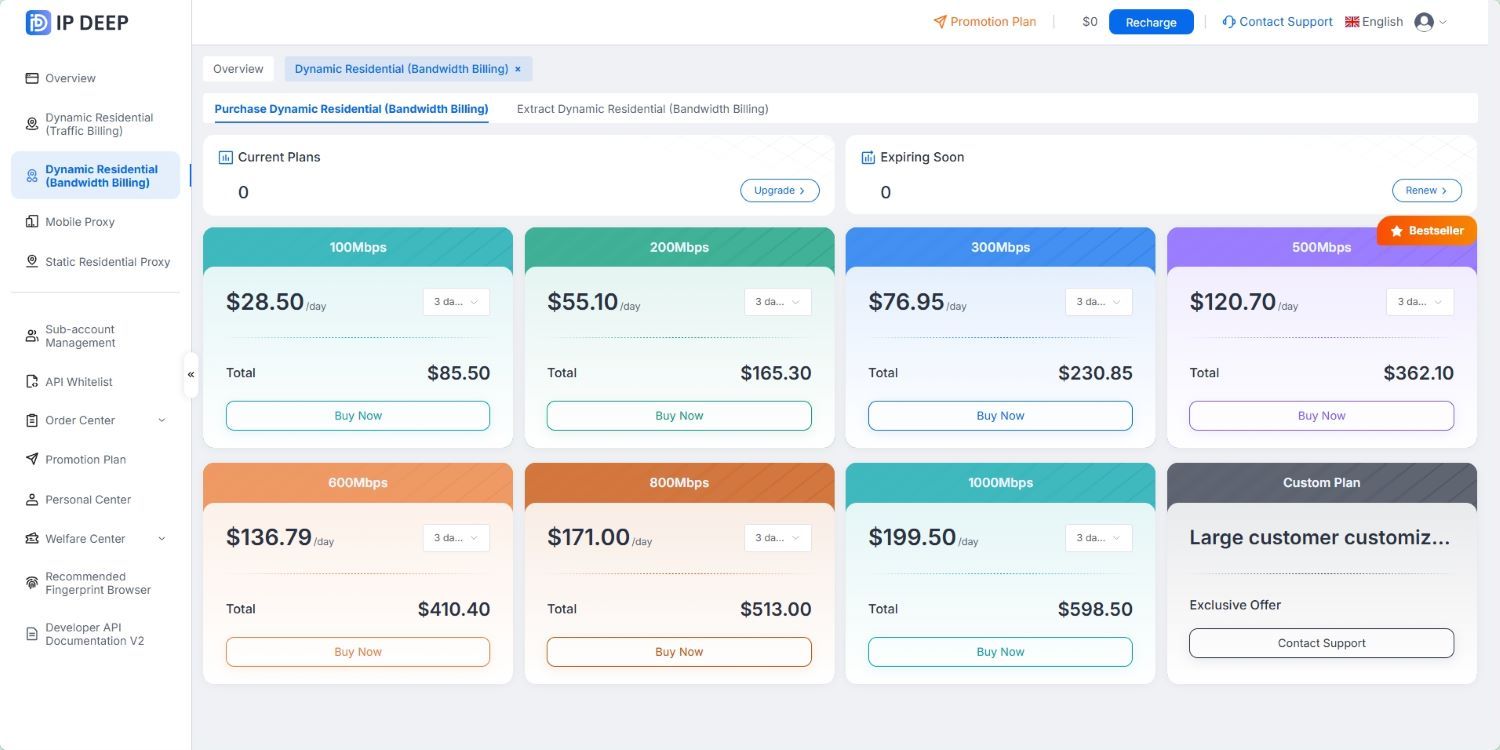
Both dynamic residential billing options support HTTP / HTTPS / SOCKS5, country/region targeting, and dynamic IP rotation.
IPDeep also provides static residential IPs for price monitoring backends and accounts that require a fixed network exit over the long term. Check the current pricing and availability on the official website.
To estimate your usage or check available plans, visit the IPDeep website for more details.
Frequently Asked Questions
Q1: Are Unlimited Residential Proxies Really Unlimited?
“Unlimited” means that you are not charged extra based on actual GB usage during the plan period. It does not mean that all resources are unlimited.
Bandwidth, concurrency, session limits, IP pool size, and regional availability still have limits. Service terms and restrictions imposed by the target website also apply.
Q2: Should I Use Dynamic or Static Residential IPs for E-Commerce Price Monitoring?
It depends on whether you need a persistent login session.
For public product pages, pricing, and inventory data, use dynamic residential IPs with IP rotation.
For backends that require long-term login sessions or a fixed exit, static residential IPs are generally a better fit.
Both can be used together.
Q3: Should I Choose GB-Based or Bandwidth-Based Billing?
For small-scale, low-frequency monitoring with limited data usage per task, GB-based billing offers more flexibility.
For tasks that need to run 24/7, monitor many SKUs, or handle significant browser rendering overhead, bandwidth-based billing makes it easier to control the budget.
You can also start with traffic-based billing for testing and switch to bandwidth-based billing once the setup is stable.
Q4: Why Do I Still Get CAPTCHAs After Changing the Proxy IP?
Platforms do not evaluate requests based on IP alone.
TLS fingerprints, HTTP headers, cookies, session consistency, request frequency, and access behavior can all be signals used by platform security systems.
Cloudflare's official documentation notes that TLS client fingerprints such as JA3 and JA4 can be used to identify client software characteristics and as signals in Bot Management.
Proxy IPs mainly address network exit and geographic requirements. Other factors need to be handled as part of the data collection system.