


Best Japan Static Residential Proxies: Top Providers in 2026



Clean IP picks: Static IPs from $1.5 each, Dynamic IPs from $0.5/GB


For cross-border e-commerce, social media management, and Japanese market research, a static residential IP provides a consistent Japanese IP address. It's useful for tasks that require the same IP over an extended period.
Which Japanese static residential proxy provider should you choose? This guide compares several popular providers based on IP type, dedicated access, protocols, pricing, and location coverage. It also explains what to check before purchasing.

How to Choose a Japanese Static Residential Proxy
A static residential proxy generally provides a residential or ISP-class proxy IP that remains the same throughout the subscription period. Providers may differ in IP source, network ownership, and hosting arrangements.
These products are often marketed as ISP proxies. The term typically refers to fixed IP addresses assigned or registered by an internet service provider (ISP) and hosted on servers. They do not necessarily run on actual home broadband connections.
When a provider labels an IP as "residential" or "ISP," check its ASN, registered location, and hosting details rather than relying on the label alone.
Use the following criteria when comparing providers:
▸ Verify the IP type and network ownership: Check the ASN, ISP, and hosting information instead of relying solely on a provider's "residential" label. Cross-check the exit IP with multiple IP lookup tools to verify its reported location and network type.
▸ Check whether the IP is dedicated: Static does not necessarily mean dedicated. Before purchasing, confirm whether the IP is assigned exclusively to you or shared with other customers. A shared exit IP may be used by multiple people at the same time.
▸ Check locations and protocols: Confirm that the provider offers endpoints in your target Japanese city and supports HTTP, HTTPS, and SOCKS5. Different tools and browser extensions may support different protocols.
▸ Review plan limitations: Check the monthly fee, bandwidth, traffic limits, renewal price, IP replacement policy, and customer support in advance. These factors determine the actual long-term cost.
Japanese Static Residential Proxy Providers Compared in 2026
The table below compares providers based on Japanese locations, pricing models, and plan limitations. Prices are taken from the providers' current official pages and may change with plan availability. Check the product page before purchasing.
Note: The four providers use different pricing models. Monthly per-IP pricing, traffic-based billing, and dedicated versus shared access cannot be directly compared on a like-for-like basis. Each figure above applies only to the specified plan or tier.
IPDEEP's promotional rate applies only to selected Tokyo endpoints and returns to the regular rate when promotional inventory runs out. Prices from the other providers vary by plan and tier.
Why Choose IPDEEP?
IPDEEP offers static residential IPs in Tokyo, Japan, with support for HTTP, HTTPS, and SOCKS5. Bandwidth options go up to 50 Mbps, making the service suitable for tasks that require a consistent Japanese exit IP over time.
Japanese endpoints are offered on a dedicated basis, meaning the same IP is not assigned to other users at the same time.
The current promotional rate for Tokyo endpoints is $2/IP/month, compared with the regular price of $3.20/IP/month.
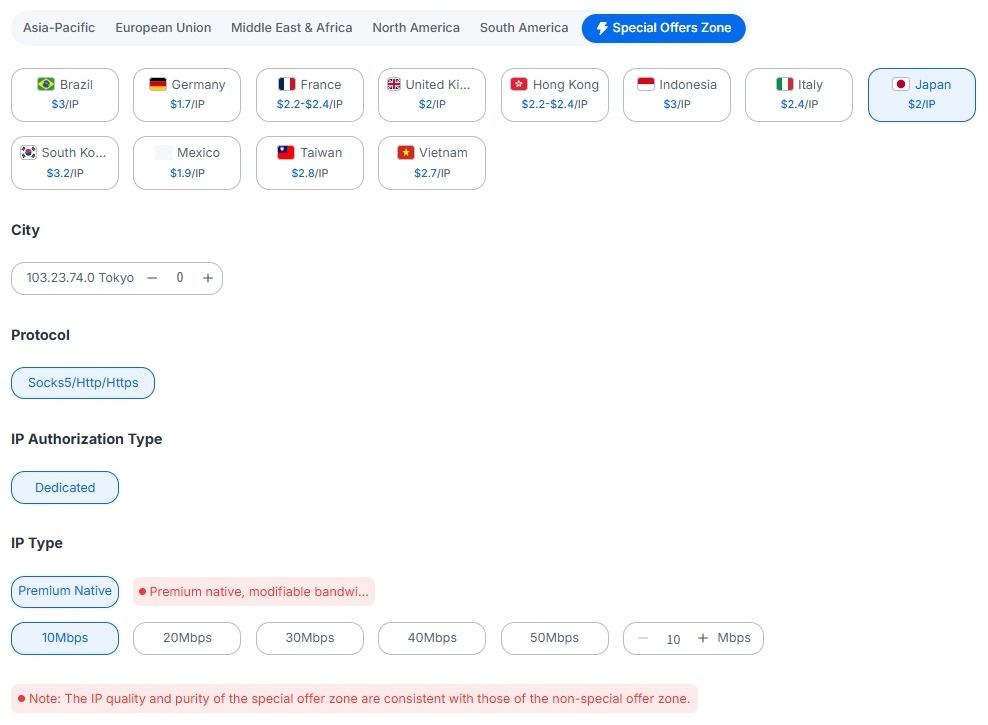
Promotional offers, inventory, and available configurations may change. Check the product page for the latest details before purchasing.
New users can check for current trials or promotional offers before choosing a plan based on their target platform, bandwidth requirements, and number of IPs.
A static residential IP provides a consistent exit IP and geographic location. It does not guarantee successful registrations, eliminate verification checks, or make an account more likely to pass a platform's review.
Actual results also depend on the target platform's rules, account status, and access patterns.
If you only access Japanese websites occasionally and do not need a fixed exit IP, a dynamic residential IP may be more cost-effective. Consider a static residential IP when you need to keep the same exit IP over the long term.
Use Cases and Frequently Asked Questions
▸ Cross-border e-commerce store management: Platforms such as Amazon Japan, Rakuten, and Mercari often require a consistent login environment. Using a fixed Japanese exit IP can reduce network inconsistencies caused by frequent IP changes.
An IP address is only one part of the setup. Keep your browser environment, login device, and usage patterns consistent as well.
▸ Managing Japanese social media accounts: For platforms such as TikTok Japan, LINE, and Instagram, a fixed exit IP can be useful for long-term logins and content publishing, reducing the need to switch networks frequently.
▸ Local market research and price monitoring: When tracking product prices, stock levels, and promotions on Japanese e-commerce platforms, a fixed endpoint can help maintain session continuity.
When collecting data, follow the target website's access rules and keep request rates within reasonable limits.
Here are some common questions to consider before buying and using a proxy.
Q1: How do static residential, dynamic residential, and datacenter IPs differ?
A static residential IP keeps the same exit IP throughout the subscription period and is suitable for long-term logins. A dynamic residential IP changes according to the provider's rotation rules and is useful for tasks that require rotating IPs.
Datacenter IPs come from hosting facilities. They are often less expensive, but their datacenter network origins may be easier to identify.
Q2: How can I check whether a Japanese IP is residential?
Check its ASN, ISP, and hosting information using at least two IP lookup tools, and verify that the reported location is Japan. Database classifications are useful references, but the IP's actual performance on your target website also matters.
Q3: What should I keep in mind when using a static residential IP?
Use a reasonable access pattern and avoid sending too many requests in a short period. Keep your browser environment, time zone, and language settings consistent with your intended location. A proxy only changes your network exit; account activity must still comply with the platform's rules.
Final Thoughts
When choosing a Japanese static residential IP, start by checking the IP type, whether it is dedicated, supported protocols, and plan limitations before comparing prices.
IPDEEP currently offers a promotional rate of $2/IP/month for Tokyo endpoints, with a regular price of $3.20/IP/month and bandwidth options up to 50 Mbps.
It's an option for long-term tasks that require a fixed Japanese exit IP. Check the product page for current specifications and availability.