




Unlimited Residential Proxies: Who Should Use Them? 5 Best Use Cases



Clean IP picks: Static IPs from $1.5 each, Dynamic IPs from $0.5/GB


Many users run into the same question when choosing residential proxies:
Do I really need an unlimited residential proxy plan? The idea of using proxies without worrying about traffic limits can be very appealing.
One of the biggest advantages of unlimited residential proxies is that you do not have to constantly calculate costs as your traffic usage increases. If you use tens or even hundreds of gigabytes each month, a fixed-price unlimited plan can make budgeting much easier.
However, unlimited residential proxies are not the right choice for everyone. Whether they make sense for you mainly depends on how often you use proxies, how much traffic you consume, and what you use them for.
So, who should consider buying unlimited residential proxies? Let’s take a closer look with the IPDEEP team.
1. Users Who Need to Access Large Numbers of Web Pages
Some users are not downloading large files every day, but they do need to access a high volume of web pages.
For example:
• Collecting and organizing website information;
• International market research;
• Checking search results;
• Browsing large numbers of pages;
• Comparing website prices and page content.
Each individual page visit may use only a small amount of data, but accessing thousands of pages over time can quickly add up. With GB-based pricing, you also need to keep checking your remaining traffic. In this case, unlimited residential proxies can be a more convenient option.
2. Users Running Long-Term Tasks
If you only use a proxy for half an hour occasionally, the benefits of an unlimited plan may not be significant.
But the situation is different if you need tasks to run continuously for several hours or for long periods every day.
The longer a proxy remains active, the more requests and traffic it will typically generate.
Common long-running tasks include:
• Website monitoring;
• Accessing overseas websites;
• Automated browsing tasks;
• Network environment testing.
For users with these types of workloads, unlimited residential proxies can be a practical choice.
3. Users Who Need Frequent IP Rotation
Some users do not need to keep the same IP address for long periods. What matters more to them is:
Whether they can access a large pool of residential IPs and switch between IPs easily.
These use cases often involve a high number of IP requests. As usage increases, traffic costs can also rise, making unlimited residential proxies more convenient.
4. Users Conducting International Market Research
International market research is another common use case for residential proxies.
For example, you may want to see what users in different countries see when they visit:
• Website content;
• Product prices;
• Search results;
• Page languages;
• Regional versions;
• Localized search results.
Simply changing your browser language or time zone may not accurately reflect a real local network environment. Residential proxies allow your requests to originate from residential networks in specific regions.
If you need to monitor multiple regions over a long period and run several tests every day, an unlimited plan can be much more convenient. This is especially true when testing multiple countries or regions at the same time, where traffic usage can quickly accumulate.
5. Users Performing Large-Scale Network Testing
Some users purchase residential proxies not simply for browsing the internet, but to test how websites perform under different network environments.
For example:
• Can users in Europe access the website normally?
• What does the website look like to users in the United States?
• Does the website display different content in specific regions?
• Does page loading speed vary between locations?
If you only run these tests once, you may not need an unlimited proxy plan. But if you perform ongoing testing or run multiple tests every day, your proxy usage can increase significantly over time.
In these cases, the fixed-cost model of unlimited residential proxies can make budgeting easier to manage.
6. How to Know If Unlimited Residential Proxies Are Right for You
The easiest way to decide is to look at your actual usage. If you use residential proxies every day, consume a large amount of traffic, and run long-term tasks, an unlimited residential proxy plan may be a better fit for your needs.
7. Frequently Asked Questions
Are unlimited residential proxies suitable for individual users?
Yes, but it depends on how much you actually use them. If you only access a few overseas websites occasionally and use very little proxy traffic each month, there may be no need to pay for an unlimited plan.
Can unlimited residential proxies rotate IP addresses?
It depends on the type of proxy offered by the provider. Some unlimited residential proxy services support automatic IP rotation, while others provide fixed residential IPs.
Which locations are available with unlimited residential proxies?
Coverage varies by provider. Common residential proxy locations include the United States, United Kingdom, France, Japan, and South Korea. If you need a specific country or region, it is best to confirm availability with the proxy provider before purchasing.
8. Conclusion
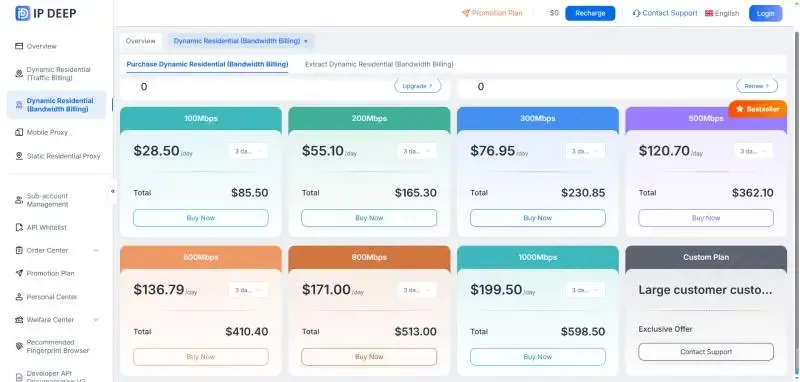
Whether unlimited residential proxies are right for you depends on your actual business needs, so there is no reason to choose an unlimited plan blindly. If you are still unsure which unlimited residential proxy provider to choose, you can take a look at IPDEEP.
Bandwidth-based pricing with unlimited IPs and traffic, stable bandwidth, and a large residential IP pool. Ideal for high-traffic use cases such as large-scale data collection, web scraping, and SEO monitoring.