




Do You Need Static Residential IPs for Shopify? Guide



Clean IP picks: Static IPs from $1.5 each, Dynamic IPs from $0.5/GB


In Shopify store operations, network environment stability directly impacts the smoothness of backend management and business continuity.
Many sellers frequently face pain points during operations, such as account verification triggered by login location changes, payment gateways requesting secondary verification, or ad accounts encountering access anomalies.
This article analyzes the practical role, core application scenarios, and selection criteria of static residential IPs in Shopify operations from a technical perspective, helping sellers build a stable and efficient network environment.

What Is a Static Residential IP?
A static residential IP is an outbound IP address assigned by an Internet Service Provider (ISP) to residential or commercial users that remains relatively stable over a long period.
Compared to hosting or data center IPs, static residential IPs combine the high trust level of residential networks with the long-term connection stability needed for ongoing operations.
To risk control systems, access behavior from these IPs closely resembles that of genuine local users.
Quick Tip: Static Residential IP vs. Dynamic Residential IP
Static Residential IP: The IP address remains consistent over time, making it ideal for scenarios requiring high environment consistency, such as daily store backend management and payment gateway logins.
Dynamic Residential IP: The IP changes frequently based on time or requests, making it better suited for high-concurrency, one-off tasks like data scraping and market research.
Why Network Environments Matter in Shopify Operations
Risk control mechanisms across Shopify and third-party services (such as payment gateways and ad platforms) evaluate risk based on multidimensional data. While an IP address isn't the sole determining factor, it serves as a critical baseline signal.
The following network behaviors easily trigger security flags:
Low Exit IP Reputation: Logging into store backends using public nodes, high-risk data center IPs, or exit IPs that have been heavily abused by multiple users.
Frequent Geographic Changes in Login Environment: IP addresses changing drastically across cities or countries within a short timeframe, leading systems to flag the activity as unauthorized access or a suspicious remote login.
Cross-account Network Sharing: Operating multiple independent stores under the same outbound IP, increasing the risk of network-level account association.
Core Value of Static Residential IPs: Providing a stable, consistent, and highly trusted network environment to minimize extra risk triggers caused by frequent network changes or anomalous exit IPs.
Key Application Scenarios for Static Residential IPs
1. Network Environment Isolation for Multi-Store Operations
For sellers managing multiple stores, configuring an independent and stable network environment for each store is a standard practice to reduce cross-account association risks.
Binding independent Shopify stores to dedicated static residential IPs effectively isolates network exit points.
2. Payment Gateway and Settlement Portal Maintenance
Payment providers like Shopify Payments and Stripe evaluate risk by considering merchant identity, payout accounts, transaction behavior, and login consistency.
A stable static residential IP helps maintain consistent access locations, reducing secondary identity checks or risk flags caused by sudden network shifts.
3. Localized Ad Campaigns and Social Media Marketing
When running local accounts on platforms like Facebook Ads, Google Ads, or TikTok, matching a trusted residential IP from the target region ensures smooth logins and lowers review rejections triggered by remote connections.
4. Precise Market Research and Local SEO Data Collection
Search engines like Google deliver tailored search results (SERPs) based on visitor location.
Using a static residential IP from the target region allows sellers to simulate local users, capturing accurate local search results, competitor pricing, and ad placements to support localized SEO efforts.
Comparing Network Options for Shopify Operations
To provide a clearer overview, here is a comparison of common network solutions:
How to Select Quality Static Residential IPs
When choosing a proxy service, prioritize the following technical indicators over low pricing:
IP Cleanliness & Reputation: Ensure the IP is not blacklisted by major risk databases and maintains a low risk score.
Genuine ISP Lines: Outbound carriers should be legitimate local ISPs providing true residential or commercial broadband attributes.
Global Coverage & Low Latency: Look for precise targeting to destination countries or cities. Optimized global nodes help keep latency low for smooth operations (actual speed depends on distance and route quality).
About IPDEEP Proxy Services
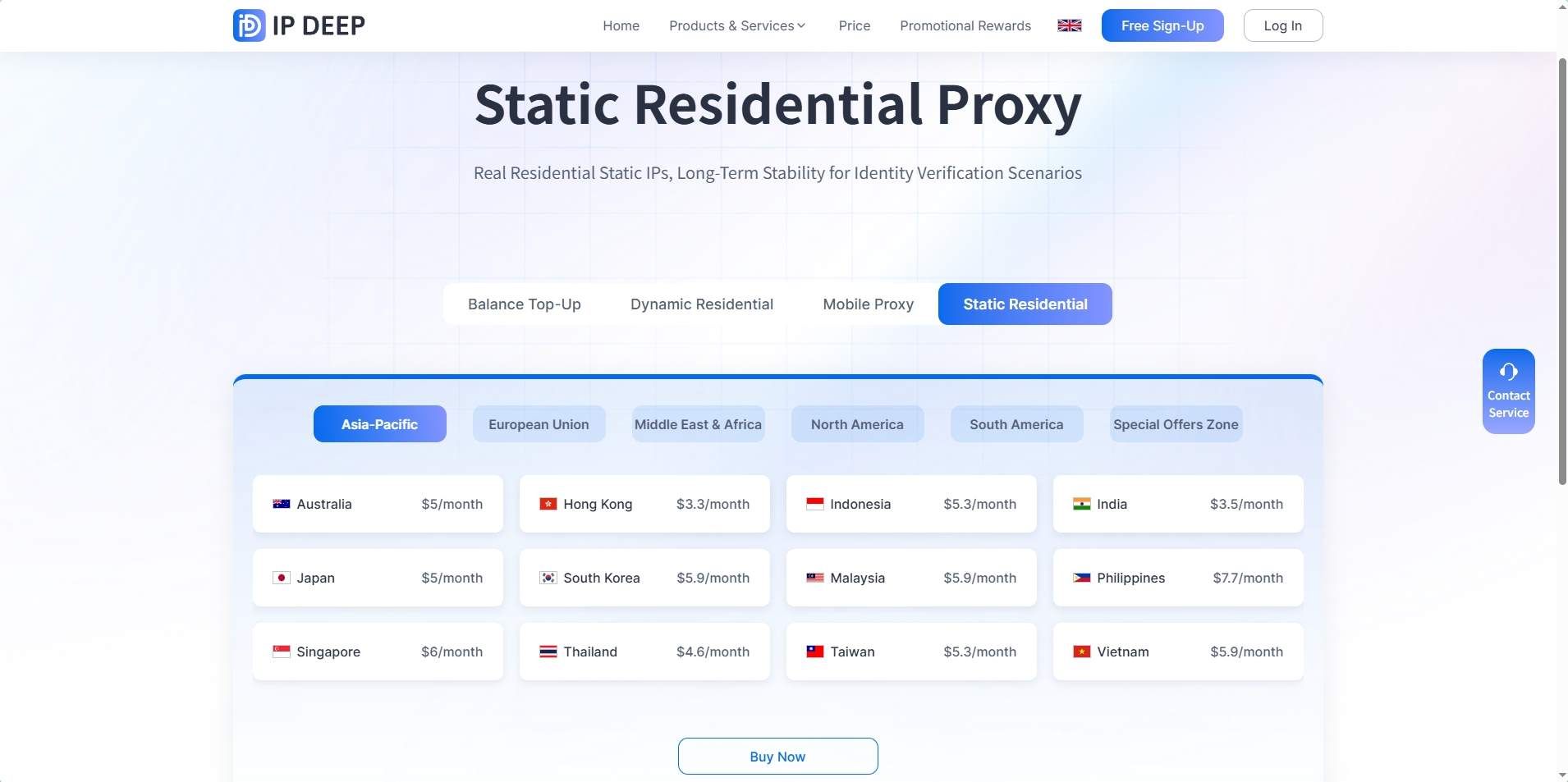
IPDEEP provides residential proxy solutions covering multiple countries and regions, supporting e-commerce stores, market research, ad verification, and other operational needs with stable, high-quality connections.
For more setup advice, visit the IPDeep Official Website for technical support.
Frequently Asked Questions (FAQ)
Q1: Is a static residential IP strictly mandatory for running Shopify?
Not strictly mandatory. For small-scale operations running a single store, standard local broadband or stable network tools may be sufficient.
However, for sellers running multiple stores, handling localized accounts, or requiring high login consistency for payment and ad platforms, static residential IPs are a practical tool to reduce risks and boost efficiency.
Q2: Will a static residential IP affect store admin loading speeds?
Speed depends primarily on physical distance and line quality.
Premium proxy providers use optimized global routing and dedicated lines to keep latency low, ensuring smooth daily order processing and backend management.
Q3: Can I use one static residential IP for multiple Shopify stores?
If the stores belong to different business entities, using separate network environments is recommended.
While an IP address isn't the only factor platforms use to link accounts, isolating network exit points is a fundamental risk prevention practice.
Q4: How do I verify if an IP has true residential (ISP) attributes?
Relying solely on an "ISP" label isn't always definitive, as some commercial broadband connections also show up as ISPs.
Use professional IP lookup tools to check parameters like Usage Type, ASN attributes, and Fraud Score for a thorough evaluation.