




Noon Operations Guide: How to Choose a Static Residential IP



Clean IP picks: Static IPs from $1.5 each, Dynamic IPs from $0.5/GB


Noon is one of the Middle East's major e-commerce platforms, operating across Saudi Arabia, the UAE, and Egypt.
For Chinese cross-border sellers, getting approved is only the beginning — after that comes managing your catalog, processing orders, maintaining inventory, and running localized operations for each target market.
In day-to-day management, the network environment is easy to overlook. Logging in from constantly changing locations or working through unstable proxy nodes makes back-office access and team collaboration harder to troubleshoot.
If you're looking for a stable Middle East network exit for your Noon store, this article walks through three areas — account compliance, fulfillment performance, and product catalog — and explains where static residential IPs fit, what to check when choosing one, and how to verify your setup once it's configured.

What Noon Sellers Need to Watch in Daily Operations
1. Onboarding and account compliance: Noon groups sellers into local sellers, international sellers, and individual sellers, and individual sellers are currently limited to the Egypt site.
Chinese sellers usually open stores in Saudi Arabia or the UAE as an International Seller. Documentation requirements look broadly like this:
▸ The business entity must be legally registered, and the business license must have at least 30 days of validity remaining at submission, with a business scope that includes one of the following: sales, trading, manufacturing, or distribution/wholesale.
▸ Tax documents: submit the relevant VAT registration information or other tax documentation based on your seller entity, target market, and onboarding route.
Some cross-border selling programs may require additional qualification approval. For specifics, go by Noon's current guidance and the outcome of your review.
▸ You need to designate a business representative, who can use a passport, a Saudi ID, or a UAE Emirates ID. If the representative is not the legal person named on the license, a power of attorney is also required.
▸ Payouts must go to a corporate bank account, and the account name must match the company name on the business license. Personal accounts are not accepted.
Noon also states that some registration details cannot be reused across multiple accounts. Opening duplicate seller accounts without explicit approval may violate platform policy.
2. Fulfillment models: Noon mainly offers two:
▸ FBN (Fulfilled by Noon): Sellers ship stock to a Noon warehouse in advance, and the platform handles storage, picking, and delivery. This is currently focused on the Saudi and UAE sites and suits sellers who want less day-to-day shipping management.
▸ FBP / self-fulfillment: Sellers hold their own inventory and ship once orders come in. It ties up less capital, but you handle logistics yourself and remain responsible for fulfillment quality.
Noon publishes clear performance standards for DirectShip (self-fulfillment): within any 7-day measurement period, the cancellation rate must stay below 2.5% and the late shipment rate below 3% (see DirectShip Seller Performance Management).
Falling short may lead to inventory delisting and offer deactivation, or in serious cases, store restriction or termination.
3. Product catalog: Listing on Noon depends on the platform catalog. If the item already exists, search for the entry and attach your offer (price, inventory, barcode, and so on) to go live.
If it doesn't exist, submit product images and attributes, and the platform generates the page after review. Review times are subject to the platform's current guidance.
Why Static Residential IPs Are Worth Considering for Noon Operations
Noon back-office work is highly continuous: daily logins, order processing, and ongoing inventory and offer maintenance. The same account usually runs in the same market for the long term.
In that scenario, whether the exit address is fixed affects how predictable your access experience is, and whether you can quickly tell whether a problem lies with your local network, the proxy node, or the platform itself.
The main difference between static residential IPs and rotating residential IPs comes down to whether the address is fixed:
For Noon operations specifically, a fixed exit pays off in three places.
First, troubleshooting cost: when back-office logins act up, an unchanged exit removes one variable, making it easier to separate a network problem from a platform-side issue.
Second, team collaboration: when several people manage the same group of stores remotely, a shared access exit is easier to manage than a random node per person.
Third, continuity: for work that involves continuous order processing or bulk inventory updates, an address that doesn't change won't interrupt sessions already in progress.
One clarification: a static residential IP means a fixed network exit — not a guaranteed safe account.
Noon has clear rules on seller account eligibility, documentation reuse, and performance, and whether an account stays operational depends on those conditions.
An IP is only one part of your access environment and cannot replace the identity and qualification review the platform requires.
A fixed exit keeps your access environment more consistent, but it doesn't guarantee you'll never trigger verification or restrictions.
Static residential IPs are usually available in fewer countries and regions than rotating residential IPs, and resources in parts of the Middle East are relatively limited. Confirm the target country actually has available resources before you order.
Four Things to Check When Choosing a Static Residential IP for Noon
Configuring and Checking Your Noon Operating Environment
▸ Fix your network exit: set up a stable IP for the environment you use long term, and cut down on unnecessary exit switching.
If your business needs to view Saudi and UAE local pages separately, choose IPs for the relevant regions based on your actual access needs, and verify the real location before use.
Whether you need a separate exit depends on team permissions, business arrangements, and platform requirements.
▸ Keep the environment consistent: match your time zone to the target site — Saudi Arabia is UTC+3 and the UAE is UTC+4.
Browser language, time zone, and similar settings just need to stay reasonably consistent with your actual office location and target market. There's no need to force an environment that doesn't match your situation.
▸ Check connection quality regularly: verify the IP's registered region, ISP information, response latency, and DNS resolution.
We recommend starting with a small test on your target site, then confirming performance and the replacement policy before configuring at scale.
▸ Follow the platform's account rules: operate within Noon's account eligibility and authorization requirements, and don't reuse registration details without approval.
Account status is determined by platform rules and store performance, and changing IPs won't resolve account restrictions.
IPDeep Static Residential IPs: A Stable Network Exit for Daily Noon Operations
For cross-border sellers managing Noon stores over the long term, a fixed and reliable network exit reduces the management overhead that comes with changing IPs frequently.
IPDeep's static residential IPs can be assessed against the criteria in the section "Four Things to Check When Choosing a Static Residential IP for Noon":
▸ Fixed, dedicated exit: the IP stays fixed for the duration of the service term and is allocated per IP, which suits long-term back-office logins and multi-person collaboration.
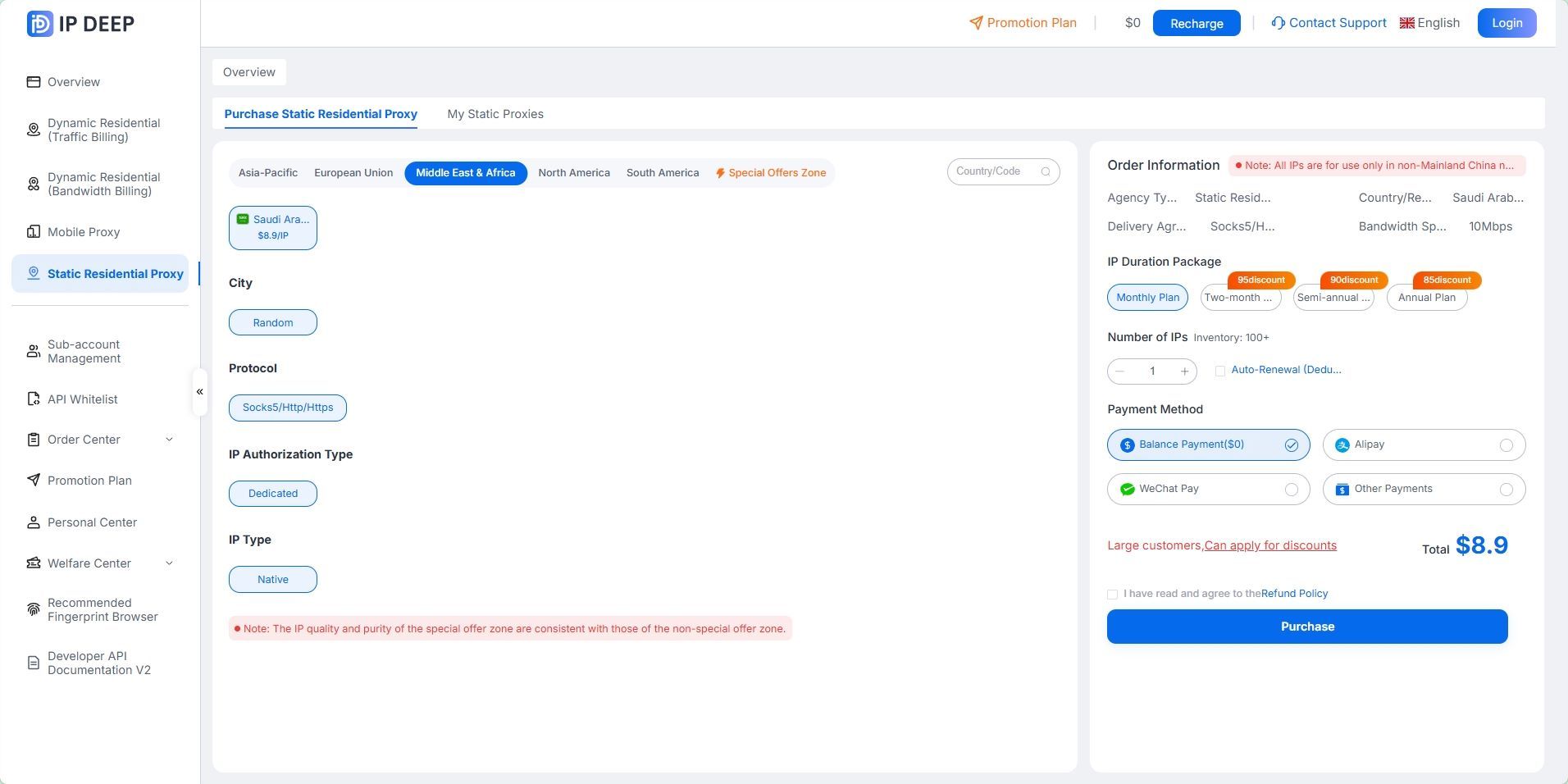
▸ Protocol support: HTTP, HTTPS, and SOCKS5 are supported. Different protocols suit different integration methods — see the static residential IP protocol guide for details.
▸ Bandwidth and regions: multiple bandwidth configurations are available, covering a range of countries and regions. Static residential coverage is usually narrower than rotating residential coverage, and resources in some regions are relatively limited.
Before you buy, confirm on the product page whether the countries and cities you need currently have purchasable resources, whether the IP is dedicated, and what the bandwidth specs and connection performance are, then configure it in your daily operating environment.
Available regions, bandwidth tiers, and pricing are subject to the current pages on the official website.
Frequently Asked Questions (FAQ)
Q1: Are static residential IPs a good fit for day-to-day Noon store operations?
If your store needs long-term back-office logins, order processing, or remote collaboration across a team, a static residential IP's fixed exit helps keep the access environment consistent and makes connection issues easier to troubleshoot.
But an IP alone doesn't determine whether an account stays operational — account status depends on documentation compliance, platform rules, and store performance.
Q2: What should I check when choosing an IP for Noon's Saudi or UAE site?
Start by confirming whether the provider currently offers static residential IPs for your target country, and verify city coverage separately if you need city-level targeting.
On time zones: Saudi Arabia is UTC+3 and the UAE is UTC+4.
Before buying, run a small test to check the IP's registered region, ISP information, and actual connection performance.
Q3: Which proxy protocols do IPDeep static residential IPs support?
HTTP, HTTPS, and SOCKS5. They work with browsers, software, and script tools that support the corresponding proxy protocols, and the exact configuration depends on the tool itself.